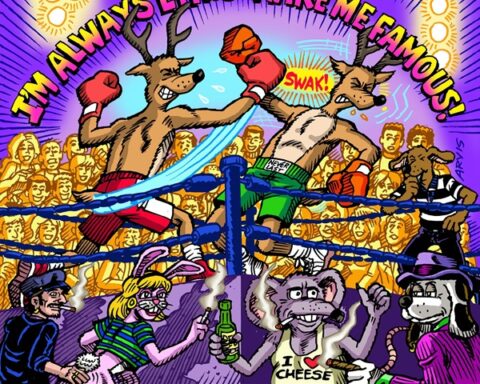
The Friendly Ghost of Alias Pail

Posted on Friday 9 May 2008

It is hardly a coincidence that so many successful indie-group groups feature a few guys and a Japanese gal, with the latter usually providing some sort of vocal role. From old favorites like Blonde Redhead and Deerhoof to recently acclaimed acts like Asobi Seksu, I believe the appeal mainly lies in both the feminine tone and cohesive structure of the language when sung aloud. Foreign audiences tend to enjoy both the exoticness and unpredictability of the tone, considering any backing instrumental styles to be an additional factor of enjoyment. Without stereotyping, the Japanese voice that typical western audiences have been most exposed to is one of a gentle, slightly high-pitched nature. When supplemented by an aggressive rush of guitars or energetic bass line, the stark contrast makes for a uniquely enjoyable experience, most evidenced by the excellent work from Blonde Redhead and Deerhoof. And even when the vocals are backed by a similarly serene setting (think of Asobi Seksu’s lush shoegaze structures), the fusion works just as well. That being said though, finding a female vocalist who can speak Japanese does not guarantee success. After all, the implemented ingenuity and enjoyment can often be traced back to one thing: the actual songwriting.

Following in the footsteps of successful bands that incorporated such a proven technique, the internationally bounded Alias Pail consists of Hektor Fontanez, Bryan Doring, and Hisako Konami. If one were attempting to define a “group effort”, this trio would provide for a pretty fantastic example. All three are proficient multi-instrumentalists within their craft of guitars, keyboards, drums, and samplers. In addition, they are all vocal participants, lending their voices to the experimental vein of pop music that should delight fans of groups like Animal Collective. Konami is a constant presence with her soft cooing, often in backing form, and both Doring and Fontanez deliver an enjoyably comparable delivery. In one of the most unique aspects of Alias Pail, all three members appear quite proficient in Japanese and several of their tracks released thus far has been exclusively sung in the language. For those without a hint of bilingualism in their system, there is no reason to fear though. While the descriptive imagery provided (in English) within the lyrical content of the excellent “Sun and Rain” supplements the summery feel of the track’s instrumental backing very appropriately, all one needs to enjoy the craft of Alias Pail is an ability to retain a simple melody. In Alias Pail’s case, their songs are likely to remain stuck in your head, even if an initial impression may give off a sentiment that their songwriting and methods of production are too ambitious to do so. But like the aforementioned Animal Collective, their eventual infectiousness arrives primarily from the source of such ambitions, not tampered because of it.

As far as background information goes, there is little known about the originations of Alias Pail. What is understood though is that all three members have a reverence for the Japanese language in general, perhaps best displayed by their collaborations with My Pal Foot Foot, a band based out of Japan that operates within similar circumstances of experimental pop despite a larger emphasis on guitar-oriented ambiance. Initially nothing more than collective pen pals, the two bands evolved into being occasional musical partners. They ended up releasing a split album in late February, My Pail Split Split, that featured 10 tracks in which the overlapping styles providing for a very enjoyable listen. Though My Pal Foot Foot have been around for over 6 years and released a handful of albums prior to the recent release, the split was one of the first official releases from Alias Pail. The serenely exhilarating “Friendly Ghost” is the concluding track on the split. Sung entirely in Japanese, the first minute or so relies on an overlapping dual vocal approach in which Konami and Doring chant melodically over a simplistic guitar progression and a variety of samples that serve to supplement the faint rhythm section. Doring eventually sings solo in Japanese after about a minute, only to be shortly reacquainted with Konami’s beautiful backing vocals when the guitar progression makes a melodic transition. The final minute is Konami’s time to shine as she provides solo vocals over a melody that - by the 6-minute mark - was stuck in my head for quite some time. The surprisingly addictive “Friendly Ghost” is a great example of Alias Pail’s intended style, with their take on experimental pop being uniquely refreshing.

I mentioned “Sun and Rain” earlier as being an extremely impressive track, but I expect so many people to enjoy it that it deserves further analysis. The instrumentally aided melodic prowess reminds me specifically of Panda Bear and Noah Lennox’s fusion of nostalgic ’60s pop with contemporary indie-pop, an aspect that should win over an ample amount of fans almost immediately. It is more structurally conventional when compared to “Friendly Ghost” and the lush near-instrumental “3 Little Stones” and - in turn - more accessible, but it does not stop Alias Pail’s trademark style from consuming the entire track in appealing form. The dual vocal technique is implemented once again, this time guided by a series of halted guitar chords that are complemented by an additional guitar that takes upon a twangy bass-like effect. The hook is established when Konami’s vocals collide with the aforementioned twang, an effect that contrasts very effectively with the slight instrumental pause preceding it. “Off into dark clouds, we go and wander,” they mutually sing during the break. “So what you wonder, who knows the weather?” The lyrics are simple and repetitive, much like the melody it accompanies, but the simplicity and repetition is all part of the song’s charm. Several subtleties like the scatterings of additional guitar progressions and the faint murmur of an organ become increasingly prevalent with each new listen, a factor that bodes well for experimental pop artists in the vein of Alias Pail. However, even if one pays the importance of attentiveness no mind, “Sun and Rain” is one of the tracks from Alias Pail that can be immensely enjoyed regardless. And even if their other tracks yearn for the time and attention, they certainly have earned the right with such precise quality.

——————————————————————————————

Alias Pail - Sun and Rain

——————————————————————————————

Alias Pail - Friendly Ghost

——————————————————————————————

Alias Pail - 3 Little Stones

——————————————————————————————

Official Web Site

MySpace

BUY

1 Star2 Stars3 Stars4 Stars5 Stars (No Ratings Yet)
Loading ... Loading ...
Mike Mineo @ 6:17 am
Filed under: Features and MP3s

Down Home Southernaires

Posted on Thursday 8 May 2008

Unless their family’s name is worth a few cool million, most young musicians are forced to get creative when attempting to generate some sort of substantial income. Like many artistic professions, the line between raking in millions per year and barely scraping by in the music industry is very thin. A most desirable situation for individuals who view music as a full-time occupation in the future would be to hold a job that allows them to devise their own schedules, opening up more opportunities for any gigs or recording sessions on the path toward a musical career that will hopefully break out one day. So, as the 4 members of Down Home Southernaires would likely tell you, a logical solution would be to find a side-career within the realm of art as well. Jose Castello, the group’s pianist, finds time to be a painter and a poet, while drummer Jorge Rubiera is a filmmaker and occasional fashion photographer. The other two members also serve in some unique side professions; guitarist Kristopher Pabon is an amateur anthropologist and bassist Jarrett Hann is on his way to becoming a professional in the culinary arts. And while all four of these childhood friends clearly have different interests based on their preferred occupations, there is a common bond that keeps these guys as the best of friends. For that, we can thank the power of music.

The occupational eclecticism of Down Home Southernaires proves to be appropriate when applied to their intended style, as the four-piece’s masterful blend of punk, R&B, ska, funk, and soul provides for one of the most unpredictably enjoyable releases of the year thus far. Packed with such stylistic fervor, the ambitious propensities tend to carry on over to the group’s actual songcraft. If you are someone who gets quickly tired of conventional song structures in pop music, Down Home Southernaires may be a great find for you. The 8 tracks on Negro En Bicicleta, the group’s newest release, all remain extensively cohesive in that one is able to identify Down Home Southernaires’ distinctive sense of individuality, but the subtle weaving of various genres within the intricate structures creates an enjoyably unique listening experience that marks the album as something of a rare entity. In an age where many artists are reluctant to mix and math a variety of styles in fear of critical backlash, Down Home Southernaires have emerged practically out of nowhere (or Miami) with a release that should hopefully encourage other new artists to promote their ambitious nature as candidly as possible. The impressive Negro En Bicicleta succeeds in such aspects for the most part, granting listeners with something that they can both relax and dance to.

I suppose that if one were forced to compare Deep Home Southernaires to a familiar face, Elvis Costello would be inescapable. Listening to the first minute or so of the curiously titled “Israelis on the Beach”, I imagine that many will scratch their heads at the comparison, but it becomes increasingly prevalent as the song evolves. Initially guided by the repetition of an electric guitar over the smattering of funk-tinged keys, the vocals of Jose Castello emerge shortly thereafter. While they initially sound somewhat out of place in contrast to the instrumental touches of funk and R&B, Castello’s vocals follow the footsteps of the song’s structure in transforming from a somewhat hesitant attempt into a full-fledged demonstration of stylistically eclectic success. The rhythm section halts briefly at around 37 seconds in as a swift piano chord establishes the entry point for the real meat of the song, featuring a variety of piano progressions over the constant urging of underlying guitars, bass, percussion. Purely as a keyboardist, Castello also remains extremely impressive, as tracks like “Israelis on the Beach” and the exotic rush of “Otro Sur (Sagan Samba)” demonstrate. And as for the Costello reference, once Castello belts out “At first I get patient at my last resort” during the bridge in “Israelis on the Beach”, it should be quite obvious that some influences show regardless of opposing intentions. In this case, it just contributes to the success even more.

Apart from good ol’ Elvis Costello, Down Home Southernaires remind me of the previously featured White Rabbits with their implementation of punk and R&b within classic forms of ska. Considering that White Rabbits’ Fort Nightly was one of the most talked-about debuts last year, I certainly believe that Down Home Southernaires have a similar degree of appeal that should open them up to a plethora of new fans. Negro En Bicicleta’s opening track, “High Effect”, takes more dues from funk and soul. Backed by a faint organ and a vigorous bass line, the funky twang of a guitar leads the budding verse. The chorus sees the re-emergence of the twinkling keys found during the track’s first few seconds, creating an instantly memorable hook as Castello laments about. “High Effect” also serves as a great example of Down Home Southernaires’ structural tendencies. You could actually say that a few tracks on the album almost seem like two or three songs in one, as the arrangements that alternate consecutively in tracks like “High Effect” and “Fishing Wire of Feeling” differ so dramatically from one another that the variation - while occasionally overbearing - is generally rewarding. “I Hate the Nightlife”, for instance, relies on a sparkling rendition of folk-pop before transitioning to an anthemic burst of key-led effervescence, sounding nearly patriotic in tone. It is surprising how well they are able to mix their preferred genres together, even if they are occasionally separate structural entities altogether. If you can deal with the constant sense of variation, Down Home Southernaire’s Negro En Bicicleta is a very gratifying listen.

——————————————————————————————

Down Home Southernaires - Israelis on the Beach

——————————————————————————————

Down Home Southernaires - High Effect

——————————————————————————————

Down Home Southernaires - I Hate the Nightlife

——————————————————————————————

Official Web Site

MySpace

1 Star2 Stars3 Stars4 Stars5 Stars (3 votes, average: 5 out of 5)
Loading ... Loading ...
Mike Mineo @ 6:15 am
Filed under: Features and MP3s

The Black Hollies Cast Their Shadows

Posted on Tuesday 6 May 2008

You could probably call it some sort of complementary bias, but I tend to be more selective when choosing which bands to feature from New Jersey. I guess it just comes down to tough love, as I would never want an artist who lingers in mediocrity to represent the place where I grew up. Springsteen has done wonders for the small (but crowded) state’s musical reputation, as have the likes of Parliament-Funkadelic and Frank Sinatra, but it has been quite some time since a newly formed act from the Garden State has turned heads. Well, the Jersey-based My Chemical Romance received a considerable amount of attention a few years ago, but I am referring more to bands who promote artistic ingenuity without being overly emotive in the process. Based out of Jersey City, The Black Hollies appear primed to be one of the more memorable acts originating from the east coast this year. Through an incorporation of their preceding influences of ‘60s soul and psychedelia with a contemporary indie-rock edge, the four-piece simultaneously express veneration for the past while demonstrating a knack for modernistic methods of production. The result is a bountiful form of psychedelic-rock that sounds strangely familiar and surprisingly effective, at least in the sense that few modern artists can capture the feel of psychedelia as well as their cherished influences from the ‘60s.

The Black Hollies formed in the summer of 2004, with all 4 of the members being good friends already. They made a habit out of hanging out in guitarist Jon Gonnelli’s attic, supplying entertainment by listening to ’60s soul records on a turntable while reading books on art, mysticism, and spiritual enlightenment. “I guess we were trying to pick up puzzle pieces of our lives while discovering new mediums to express our ideas,” lead singer and bassist Justin Angelo Morey explained. “I suggested trying to write similar music to the others and eventually we pulled the power plug of the record player out of the wall socket and turned ourselves on.” The jump from being observers to actual participants seemed only natural to the band, as all 4 members were well-aware of the common musical interests that they all shared. With that in mind, the release of their debut album, Crimson Reflections, was quick to follow in 2005. The group saw the release as an experiment of sorts, mixing together ’60s soul with accessible indie-rock to create a generally amiable listening experience. It had its rough edges, but Crimson Reflections drew acclaim nonetheless and produced an ample local fan base in the process. Guitarist Herbert Joseph Wiley V and drummer Scott Bolasci rounded out the quartet, though Bolasci was recently replaced with Nick Ferrante. Hot off performances at SXSW and CMJ that they deemed “unforgettable”, The Black Hollies are prepared to release their anticipated follow-up in the improved Casting Shadows.

The most glaring improvement found on Casting Shadows when compared to the preceding Crimson Reflections is the addition of psychedelia to the group’s stylistic equation. The band has always been followers of the style and they appear to enjoy just as much as soul and rock music, but they appeared to have some difficulty capturing the style on their debut. This resulted in a record that was occasionally predictable, albeit very enjoyable in the moments that were stylistically unwavering. The first track on Casting Shadows, “Whispers Beneath the Willows”, provides for immediate proof that the group’s stylistic boundaries are expanding considerably after only one prior release. Morey’s quivering vocals take on a slight warble of reverb, almost sounding like some tortured soul stuck in a vacuum. A steady repetition of twangy guitar progressions reverberate over a rhythm section that collapses and re-emerges sporadically, all until it is suddenly uplifted in velocity when the chorus makes its entry. When there, we find Morey engineering a series of collaborative dual vocals before a more diversified verse materializes. Overall, it is a very satisfying opener that sees the band at a much more matured stage at this early stage in their careers. The songwriting is stellar with a variety of hooks and the production is adjusted appropriately to the track’s specific leanings in psychedelia.

“Paisley Pattern Ground” should most certainly appeal to listeners who prefer garage-rock to the album’s more focused psychedelic intent. Though Morey’s vocals provide for the same form of quivering psychedelic tinge during the track’s chorus, the halted chords of the verse remains more reminiscent of garage-rock revivalists in the vein of Jet and The Vines. “Oh baby watch your step,” Morey snaps over the angsty rush of guitars. “You’re gonna dress like that.” His vocals take a turn from yelping garage-rock to quivering psychedelia as the verse and chorus alternate, being a rather tidy summation of the band’s stylistic capabilities. I personally prefer the more ambitious scope of “Whispers Beneath the Willows” and “Under a Winter’s Spell” to the straightforward “Paisley Pattern Ground”, but I foresee the track receiving considerable radio airplay nonetheless. “Under a Winter’s Spell” finds Morey sounding eerily similar to George Harrison himself, with the songwriting not a far cry from the Fab Four’s more psychedelic works. The guitar work of Gonnelli and Wiley is also particularly impressive, providing a sense of further variation over the constant rush of the bustling rhythm section and Morey’s impressively suitable vocals. Casting Shadows is available in stores now and is recommended for those who enjoy a fluid mixture of psychedelia and garage-rock.

——————————————————————————————

The Black Hollies - Whispers Beneath the Willows

——————————————————————————————

The Black Hollies - Paisley Pattern Ground

——————————————————————————————

The Black Hollies - Under a Winter’s Spell

——————————————————————————————

MySpace

BUY

1 Star2 Stars3 Stars4 Stars5 Stars (4 votes, average: 4.25 out of 5)
Loading ... Loading ...
Mike Mineo @ 6:17 am
Filed under: Features and MP3s

Silje Nes’ Serenely Optical Room

Posted on Monday 5 May 2008

Created by ophthalmologist Adelbert Ames, Jr. in 1934, an “Ames room” is considered to be one of the most revered examples of an optical illusion. To sum it up, the room contains distorted dimensions that allows an observer to view two participants standing in separate corners, with one appearing as a giant and the other appearing as a dwarf despite their actual sizes being the same. When Silje Nes decided to name her debuting album Ames Room, I imagine that she had at least some idea as to how remarkably appropriate it was in appliance to her style. To a passing observer with a small degree of attentiveness, one may perceive Nes’ work as little more than a lush form of atmospheric invigoration. It is true, of course, that Nes’ mixture of twinkling xylophones and lightly strummed guitars provides for a listening experience that contributes immensely to a listener’s preceding feeling of relaxation, but what Ames Room will treat to the listeners who look even more closely is something of a unique marvel. Like electronic experimentalists in the vein of Tujiko Noriko and Haco have proven over the past decade, the most prevalent factor of enjoyment is occasionally found within the subtle intricacies of the respective work. And for the talented Silje Nes, it appears as if the marvelously titled Ames Room is both a result of this cultured belief and the undeniable talent that the Norwegian songwriter encompasses.

Nes’ musical beginnings trace back to 2001, a time when she had little musical resources other than a demo of some 4-track software and one of those little built-in microphones that come with most standard laptops. I suppose that this could be considered the most productive way for an aspiring musician to start out, with no forms of bloated production interfering with the songwriting and artistry of the musician’s work. By the time she started fiddling around with amateur recording, Nes’ background was rooted primarily in her studies of classical piano. Since many consider it to be arguably the most difficult conventional instrument to grasp, it came as no surprise that Nes was quick to adapt when learning other instruments like guitar and drums. Quite boldly, she decided to implement these new instruments into her recording. While most would expect several discordances out of such a daring approach, all of the material she has released so far has been surprisingly polished considering her bare arsenal. Even more impressively, Nes’ ability to tread in the waters of avant-garde electronica is uncommon for someone who previously had little knowledge of production or instruments outside of the piano. However, as Ames Room sturdily teaches, a background in theory and a boatload of talent can go a long way.

Silje Nes’ debut album, Ames Room, encompasses material that the Norwegian artist has written between late 2004 and the summer of 2007. Nes sent the Brighton-based FatCat Records an early demo in 2005 and the label was immediately fascinated with her compelling style. She chose the right one to send her material to as well, as FatCat is host to ambitiously acclaimed acts like Animal Collective, No Age, and the methodically similar Aoki Takamasa and Tujiko Noriko. Knowing since 2005 that she had the backing of a reputable international label who were known to sign artists with no stylistic restraint, Nes’ connectivity with FatCat allowed her to write and complete Ames Room without any hesitation. Somewhat unfamiliar with American audiences, I imagine that it brought her some comfort and ease in knowing that FatCat was appropriately gearing her sound toward listeners with an open-minded perspective. I have learned that this site is host to listeners with a similar mindset too, so I would be surprised if this post does not go over well. Regardless, when listening to Ames Room, it is easy to recognize how accomplished it is. While listeners who strive for immediate hooks may be turned off due to the unique nature of the release, the beauty of Ames Room comes in the unpredictably eclectic approach that Nes uses in each one of her songs.

Apart from the opening “Over All” (which she wrote with Kristian Stockhaus), the entirety of Ames Room was written and recorded by Nes. A bedroom effort at its finest, the album provides for a constant state of tranquility that few debut albums have matched. Much of it can be attributed to Nes’ breathy vocals, an aspect that coos and hums its way over melodies that are most commonly serene, inviting, and even tropical on occasion. “Dizzy Street” is unique for the minimalist Nes in that it is one of the tracks on the album with the most layers, providing a breezy chord-based acoustical melody over an underlying guitar progression that is eventually supplemented by the twinkling of keys. While electronica is not utilized as prevalently as contemporaries like Noriko, Nes’ use of backing audible effects like the sound of bubbling or clicking over an already present percussion is usually effective. “Bright Night Morning” is the type of track that lies on such aforementioned subtle beauties. It initially works purely off of a guitar and percussion, but as Nes’ enthralling vocals intensify in emotion, the use of a cello becomes increasingly prevalent. While not immediately noticeable unless the listener is attentive, the effect is beautiful for those who take notice. “Drown” is more typical of dreamy indie-folk, drawing comparisons to Marissa Nadler and Russian Red. Apart from the reverbed hush of Nes’ vocals, the approach found in all three featured tracks differ dramatically. This is one of the components that makes Ames Room such an enjoyable listen, marking Silje Nes as yet another eclectically invigorating addition to FatCat’s lineup.

——————————————————————————————

Silje Nes - Dizzy Street

——————————————————————————————

Silje Nes - Bright Night Morning

——————————————————————————————

Silje Nes - Drown

——————————————————————————————

Fat Cat Records

MySpace

BUY

1 Star2 Stars3 Stars4 Stars5 Stars (4 votes, average: 5 out of 5)
Loading ... Loading ...
Mike Mineo @ 6:12 am
Filed under: Features and MP3s

Obscure Sound: Best of April 2008

Posted on Friday 2 May 2008

It is a rare when a month does this, but I cannot recall a moment in April where I did not have something new and enjoyable to listen to. Whether I found myself humming to southern-rock, Swedish pop, intricate shoegaze, or sample-led electronica, both the diversity and quality presented by this month’s featured artists did not fail to please. I didn’t really appreciate the consistency of quality this month until I compiled this month’s compilation, featuring releases by the likes of My Morning Jacket, Quiet Village, The Explorers Club, and Bryan Scary that are already a few of my favorites for the year. If you have not been following the posts for the past few months, I hope these tracks find as much enjoyment for you as they did for me.

01. My Morning Jacket - Two Halves (post)
02. The Explorers Club - Don’t Forget the Sun (post)
03. Quiet Village - Pacific Rhythm (post)
04. Håkan Hellström - För sent för Edelweiss (post)
05. Bryan Scary & The Shredding Tears - Flight of the Knife (Part Two) (post)
06. Centro-matic - Quality Strange (post)
07. Chin Chin - Miami (post)
08. This Is Ivy League - London Bridges (post)
09. Cinderpop - Cinnamon Winter (post)
10. Soundpool - The Divides of March (post)
11. Russian Red - Nice Thick Feathers (post)
12. Bravo Johnson - Are You Dreaming? (post)
13. Bill Priddle - Like to Smoke (post)
14. Years Around The Sun - Failing At Art (post)
15. Needers & Givers - Digging (post)

DOWNLOAD ENTIRE COMPILATION>>> (55.3MB, .RAR)

1 Star2 Stars3 Stars4 Stars5 Stars (8 votes, average: 4.5 out of 5)
Loading ... Loading ...
Mike Mineo @ 6:04 am
Filed under: Best-Of Compilations and MP3s

Bravo Johnson

Posted on Wednesday 30 April 2008

In their first few tours, it would make sense for an up-and-coming band to open for artists whose style is generally reminiscent of their own. With the more experienced band of the two most often responsible for the bulk of attendance, it allows the newer band to perform for a group of people who already enjoy a similar sound, instilling more confidence in the band’s members and increasing the likelihood of an amiable reception dramatically. For a band like Bravo Johnson, I imagine that selecting a touring partner came rather easily. Since they debuted in 2006, the LA-based 4-piece has already released several hours’ worth of material that makes a strong case for them being one of the most eclectic Americana acts around. But such a classification would also beg the question: If Americana is consistently classified as a degree of American roots music with a massive array of implemented styles that include folk, blues, and rockabilly, isn’t the stylistic diversity to be expected? For the majority of artists, the specified approach is integrated in a way that it consistently determines the presented style, with each and every song mainly sticking to a formula that blends such approaches consistently throughout a release. The striking thing about Bravo Johnson is that, instead of sticking with one supreme blend of sorts, they have the confidence to toy around with a variety of styles on a song-to-song basis; it is the type of enjoyable Americana that sounds neither repetitive nor desperate.

It was just last week when I wrote about a double-album release from Centro-matic, a group who has been steadily writing great songs for over a decade. Like the mentality demonstrated through their varied style, Bravo Johnson once again show their boldness in commendable form by releasing a double-album, The Crooked and the Straight, only two years into their lifespan. An extremely risky choice it may be, but after listening to both discs in full, it appears that it may have been the right choice after all. As I reiterated in the Centro-matic feature, too much material in one release can obviously be overwhelming to some listeners, but quality will always prevail in the end. And while listening to the entirety of The Crooked and the Straight in one sitting is not recommended (listening to the same artist for two consecutive hours can sometimes get tiring, regardless of the quality), the consistency of quality that is spread throughout the majority of the release is quite impressive. Instead of relying on a traditional structural formula in which one disc encompasses an audibly involved (electric) sound while the other demonstrates a more restrained (acoustic) style, both have their share of tracks that could fit into both categories.

Bravo Johnson are led by the eclectic songwriting of Rick Amurrio, a multi-instrumentalist who also provides his talents on guitar, piano, and Wurlitzer. Guitarist Hendrik Roever, bassist Hendrik Roever, and drummer Iñaki García. Brian Miller also supplied keys on The Crooked and the Straight, with the instrument being one of several driving forces in the standout “Are You Dreaming?”. Guitars, keys, and a glaring harmonica establish the track’s irresistible melody, uplifted in invigorating form by the emotive twang of Amurrio’s commendable vocal delivery. The keys establish the hook during the chorus with the swift placement of several successive chords, gradually shifting lower in tone before the verse is once again re-introduced. It is currently my favorite track on the album due to its catchy melodic form, complements of the contagious arrangement and the efficiently utilized vocals. Amurrio has drawn vocal comparisons to Tom Petty since the release of Bravo Johnson’s debut, Aimless Drifting, in 2006, and though “Are You Dreaming?” is not the best example of the similarity on the album, it is certainly apparent in some form. If you want to hear something a bit more comparatively accurate, take a listen to “Ace in the Hole”. An amiable mixture of rockabilly and alternative, the style itself sounds more accurate of latter Neil Young. But regardless of which aspect of the track you are eager to relate, both Young and Petty are extremely complementary comparisons regardless.

As expected within the genre of Americana, a variety of twangy guitars are utilized in masterful form thanks to Roever, as he displays his knack for most commonly traditional types of guitars in the genre’s existence (dobro, banjo, and steel are just a few). Tracks like “Aimlessly Drifting” manage to fuse the variety of guitars together into one cohesive delivery, defining the diverseness of Americana as concisely and effectively as possible. The style at heart is folk, but - thanks to the impressive fusion of guitars - the track provides enough shades of country and alternative-rock to comfort all types of listeners. This type of approach is extremely prevalent throughout all 26 tracks on The Crooked and the Straight, with it never getting tiring despite the length. If one is looking for more immediate satisfaction, “Hot Wheels” seems like the right route. Featuring yet another Petty-esque chorus that just begs to be sung along to, it seems like a pretty likely choice for a single, especially given the excellent transitional moments where the track shifts into rockabilly before reverting back to the original Americana brew. Alongside the excellent “Are You Dreaming?”, it serves as one of the most accessible tracks on the album. Though the second disc generally pales in comparison to the excellent consistency of the first half, The Crooked and the Straight serves as a very impressive double-album that should most likely usher in Bravo Johnson as one of the breakthrough Americana artists of 2008.

——————————————————————————————

Bravo Johnson - Are You Dreaming?

——————————————————————————————

Bravo Johnson - Hot Wheels

——————————————————————————————

Bravo Johnson - Aimlessly Drifting

——————————————————————————————

Official Web Site

MySpace

BUY

1 Star2 Stars3 Stars4 Stars5 Stars (No Ratings Yet)
Loading ... Loading ...
Mike Mineo @ 6:11 am
Filed under: Features and MP3s